- sales@hot-mining.com +86 28 8331 1885 +86 15196677188
-

-

-


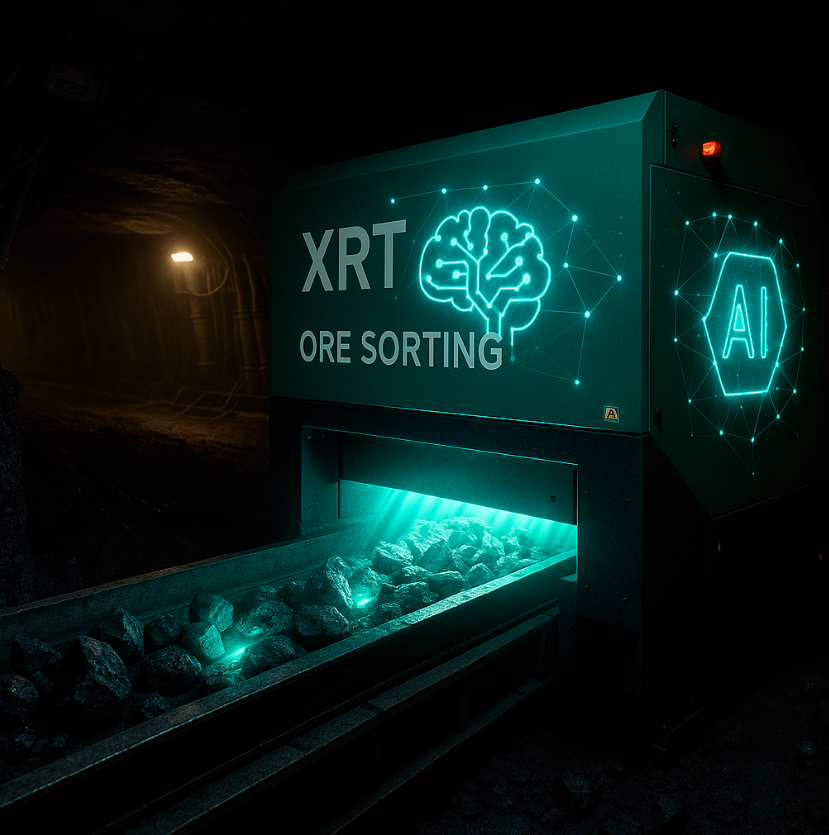
Deep underground, thin bands of rock embedded within coal seams can create a disproportionate challenge for coal preparation. Known as gangue bands or stone bands, these inclusions may be only 0.02–0.06 metres thick, yet they can significantly affect sorting performance, product quality and operating costs.
Three challenges make gangue separation particularly difficult:
1. The density trap
Argillaceous gangue can have a density of approximately 2.0–2.7 g/cm³. Where its physical properties overlap with those of other materials in the feed, conventional X-ray systems relying primarily on density-related contrast may struggle to distinguish it reliably.
2. The fine-particle challenge
Small gangue particles, particularly those below 5 mm, can be difficult to detect and separate. Weak or ambiguous detection signals may result in misplaced material and the unnecessary rejection of coal-bearing particles.
3. The ash-content problem
Gangue entering the clean coal stream increases ash content and reduces fuel quality. For coal preparation plants and power stations, this can mean lower calorific value, reduced product consistency and additional processing costs.
The industry therefore needs more than basic material detection. It needs sorting systems capable of interpreting complex material characteristics and making accurate separation decisions.
This is where dual-energy X-ray technology and multimodal AI enter the picture.
Dual-energy X-ray technology uses two different energy levels to examine material characteristics from complementary perspectives.
The original article identifies two energy levels—100 keV and 160 keV—as an example of this approach.
1. Complementary energy measurements
Low-energy X-rays: Provide information related to material composition and differences in X-ray attenuation.
High-energy X-rays: Offer complementary transmission information, helping the system distinguish materials with different physical and compositional characteristics.
By comparing the responses at different energy levels, a sorting system can obtain more information than it would from a single-energy measurement.
The concept is similar to extending a conventional image into a more informative material-characterisation process. Rather than relying on one signal, the system evaluates how the material responds under different X-ray conditions.
2. Thickness compensation
Material thickness can influence X-ray transmission and affect the interpretation of detection signals. The original article attributes thickness compensation to a patented dual-layer crystal detector design.
The intended benefit is to reduce the influence of differences in particle thickness and improve the consistency of material identification.
The source also claims that the technology can detect gangue layers as thin as 0.03 mm. This specific performance figure requires confirmation against the manufacturer's technical documentation and test conditions.
3. Reported sorting performance
According to the original article, a coal mine in Kazakhstan recorded an increase in gangue recognition from 75% to 92%, with an estimated revenue improvement of RMB 80 per tonne of coal.
These figures illustrate the potential economic value of improved gangue identification. However, the comparison conditions, measurement method and calculation basis need to be verified before they are presented as independently established results.
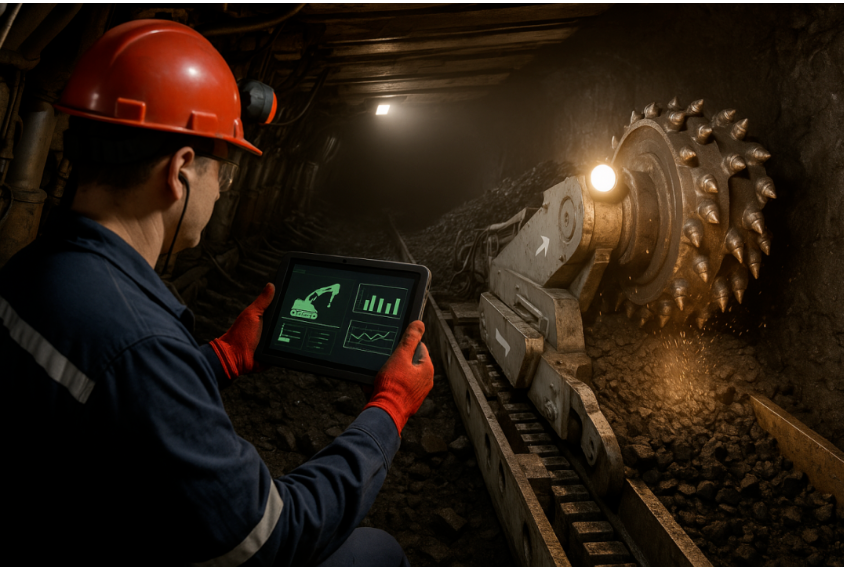
X-ray detection provides valuable information, but complex coal streams may require additional interpretation. Multimodal AI offers a way to combine different types of information and support more informed sorting decisions.
The proposed architecture includes three key elements:
1. Transformer-based analysis
Transformer models can process sequences of information and identify relationships across multiple observations. In a dynamic coal stream, this type of architecture could help analyse changes in material characteristics over time and support the tracking of particle movement.
2. Graph Neural Networks (GNNs)
Graph Neural Networks are designed to process relationships between connected objects. In a sorting application, a graph-based representation could help describe the spatial relationships between particles, gangue bands and material boundaries.
This may provide additional context for identifying complex structures that are difficult to interpret from isolated measurements.
3. GPU-accelerated processing
GPU computing can accelerate the processing of large volumes of detection data. The original article claims that the proposed system can complete its calculations within 5 milliseconds.
Actual processing latency depends on the model architecture, input size, hardware configuration and the complete detection-to-actuation workflow. The 5 ms figure should therefore be treated as a performance claim requiring technical validation.
Identifying gangue is only part of the sorting process. Once a target particle has been recognised, the system must locate it accurately and separate it at precisely the right moment.
This is where the ejection mechanism becomes critical.
HOT Intelligent Technology's proposed sorting approach uses a micro-nozzle array to direct compressed-air jets towards selected particles.
The system combines detection, position tracking and timed pneumatic actuation to separate target material from the coal stream.
The original technical description highlights two parameters:
Positioning accuracy: 0.1 mm.
Compressed-air pressure: 6–8 bar.
These specifications are intended to support precise particle ejection and reduce unnecessary disturbance to surrounding material.
In practical operation, sorting performance depends not only on nozzle positioning and air pressure, but also on particle size, belt speed, particle spacing, air-valve response time and the distance between detection and ejection.
The objective is to turn intelligent recognition into reliable physical separation.
The following table presents the three-stage development framework described in the original article.
| Technology Generation | Identification Principle | Claimed Recognition Accuracy | Adaptable Particle Size |
|---|---|---|---|
| First-generation single-energy XRT | Greyscale and density-related contrast | 75% | ≥13 mm |
| Second-generation dual-energy XRT | Differences in X-ray attenuation and material composition | 92% | ≥8 mm |
| Third-generation multimodal sorting | Combined material, texture and spatial information | >95% | 2 mm |
The progression reflects a shift from relying on a single detection signal towards combining multiple sources of information.
Single-energy XRT provides a foundation for identifying material differences. Dual-energy systems introduce complementary X-ray measurements, while multimodal approaches seek to integrate material characteristics, spatial relationships and AI-based interpretation.
The accuracy and particle-size figures shown above are claims from the source material, not universal performance limits for each technology generation. A fair comparison requires consistent feed material, particle-size distribution, throughput, operating conditions and accuracy definitions.
The next stage of intelligent coal preparation may involve moving sorting operations closer to the point of extraction.
The original article describes an underground sorting application in the Ordos coalfield, Inner Mongolia, as an example of this direction.
Three potential developments are highlighted:
1. Underground pre-concentration and gangue rejection
Installing XRT sorting equipment underground could allow waste rock to be separated before it is transported to the surface.
If technically and economically feasible, this approach could reduce the volume of material requiring transportation, lower haulage demand and improve overall mine logistics.
The source claims that underground sorting can reduce transportation volume by 40%. This figure should be verified against the relevant project data and the definition of the baseline transportation volume.
2. Continuous AI adaptation
Coal seams and feed characteristics can vary across mining areas. An intelligent sorting system therefore needs to adapt to changing material conditions.
The proposed incremental-learning approach is described as updating the model every eight hours. This would allow the system to incorporate new operational data and adjust to changes in the feed.
In practice, the update frequency, validation process and safeguards against model drift would need to be established to ensure stable and reliable performance.
3. Water and energy efficiency
Pre-concentration can potentially reduce the amount of material entering downstream processing circuits. This may lower water consumption, energy demand and the volume of tailings generated.
For a plant processing 5 million tonnes of run-of-mine coal annually, the original article estimates that one sorting unit could save 100,000 tonnes of water per year.
This estimate requires confirmation of the plant's operating hours, feed characteristics, process configuration and water-consumption baseline. The actual savings would depend on the extent to which sorting reduces downstream washing requirements.
From TOMRA's DUOLINE® dual-energy X-ray technology to HOT Intelligent Technology's proposed multimodal AI sorting approach, the development of intelligent sorting is moving beyond basic material recognition.
By combining X-ray measurements, AI-based interpretation, spatial analysis and precision pneumatic separation, the next generation of sorting systems aims to make more informed decisions about what to retain and what to reject.
The objective is not simply to identify gangue, but to understand its characteristics, locate it accurately and separate it efficiently.
As these technologies continue to develop, they could help coal preparation plants improve product quality, reduce the loss of valuable coal and make better use of water and energy resources.
The future of intelligent sorting is not just about seeing the rock. It is about understanding the material—and knowing exactly what to do with it.