- sales@hot-mining.com +86 28 8331 1885 +86 15196677188
-

-

-




AI-driven mineral exploration can use Bayesian decision-making and sequential planning to optimise drilling strategies under uncertainty.
Stanford Mineral-X developed the Intelligent Prospector framework, with version 2.0 extending drill planning to account for epistemic model uncertainty.
The framework uses a Partially Observable Markov Decision Process (POMDP) to evaluate drilling decisions and the value of new information.
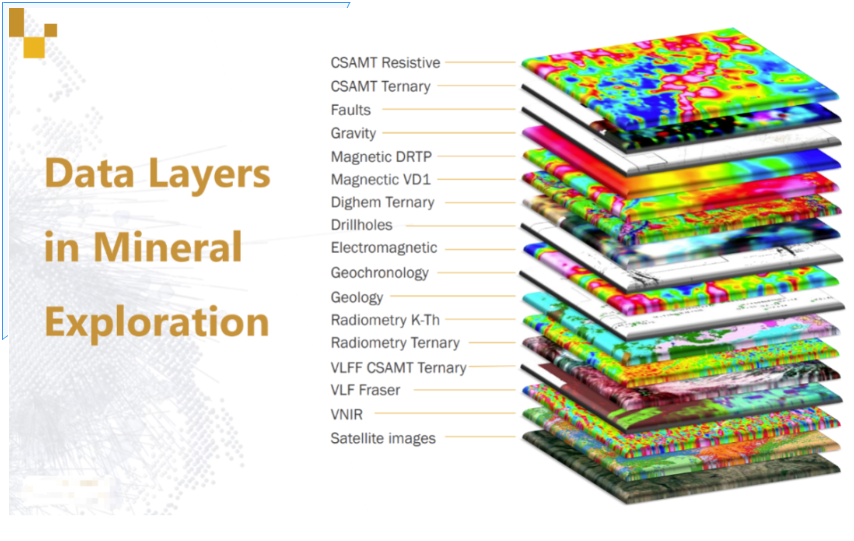
Bayesian belief updating allows the system to revise geological interpretations as new drilling observations become available.
KoBold Metals and Stanford Mineral-X have a documented research collaboration dating back to 2019, including AI-assisted drill planning associated with a major copper discovery in Zambia.
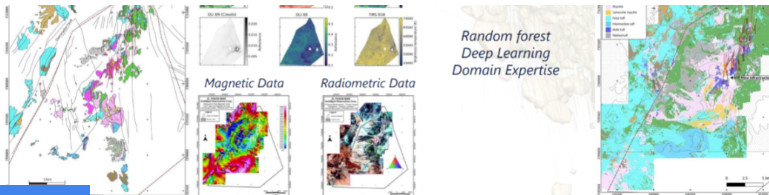
Artificial intelligence is increasingly changing how mineral exploration companies evaluate geological data, identify exploration targets and plan drilling campaigns.
Traditional exploration relies heavily on geological interpretation, geophysical surveys, geochemical sampling and systematic drilling. However, drilling is expensive, and geological conditions are often poorly understood during the early stages of exploration. Determining where to drill next is therefore not simply a geological problem, but also a decision-making problem under uncertainty.
AI systems such as Stanford Mineral-X's Intelligent Prospector are designed to address this challenge by optimising the acquisition of new geological information. Rather than treating drilling as a fixed programme, the system evaluates successive drilling decisions based on current knowledge and the potential value of future observations.
This approach combines Bayesian decision-making, sequential planning and geological modelling to support more informed exploration decisions.
The underlying approach is built around several key principles.
The system begins with geological hypotheses developed by human experts. These hypotheses represent the initial understanding of the subsurface, including possible mineralisation patterns, geological structures and spatial distributions of mineral grades.
As new drilling data becomes available, the system updates its assessment of these hypotheses through Bayesian inference. This allows geological interpretations to evolve as evidence accumulates, rather than remaining fixed throughout the exploration campaign.
Drilling decisions are made sequentially. Each new drillhole provides information that may influence the next drilling decision.
The system considers not only the immediate value of drilling a particular location, but also how the information obtained could improve future decisions. This is known as the value of information.
The objective is to make exploration more efficient by prioritising data acquisition that is expected to contribute the most to decision quality.
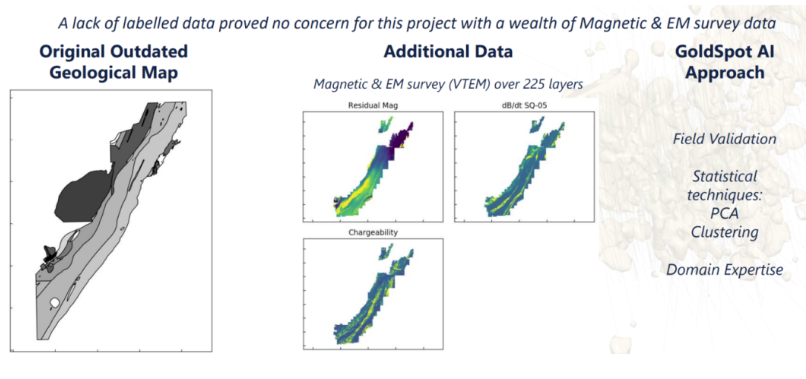
Geological uncertainty can arise from spatial variability in mineralisation as well as uncertainty in the underlying geological model.
The v2.0 framework specifically addresses epistemic uncertainty—the uncertainty associated with incomplete knowledge, assumptions or competing geological interpretations.
By accounting for the possibility that the initial geological model may be incorrect, the system can evaluate alternative interpretations and adapt its exploration strategy as new evidence becomes available.
Intelligent Prospector uses a framework based on the Partially Observable Markov Decision Process (POMDP).
A POMDP is designed for decision-making when the true state of a system cannot be directly observed. In mineral exploration, the actual distribution of mineralisation and the geological structure of a deposit are unknown. Drilling provides partial and potentially noisy observations of that underlying reality.
The framework can be understood through five components.
The state includes the underlying geological conditions, potential geological hypotheses and the current status of the exploration programme.
Geological variables may include mineral grade, thickness, depth and spatial distribution. The state is only partially observable because the true geological configuration cannot be known in advance.
Actions represent decisions about where to conduct the next drillhole or what information to acquire.
The system evaluates possible actions based on their expected contribution to the exploration objective, taking into account both the immediate outcome and their potential influence on future decisions.
Drilling produces observations such as mineral grade, lithology, thickness and geological contacts.
These observations provide new evidence about the deposit and help determine whether the existing geological interpretation remains consistent with the data.
Instead of maintaining a single assumed geological state, the system maintains a probability distribution over possible states or hypotheses.
Bayesian updating adjusts this distribution as new drilling observations are received. The updated belief becomes the basis for the next planning cycle.
The decision-making process evaluates potential actions through a reward function.
Depending on the model formulation, the reward may reflect economic value, drilling costs, exploration objectives and the expected benefits of acquiring additional information.
The goal is to identify a drilling strategy that delivers the greatest expected value over the exploration programme rather than optimising each drillhole in isolation.
The technical framework of Intelligent Prospector v2.0 centres on POMDP formulation, Bayesian inference, uncertainty modelling and sequential decision-making.
The exploration problem is represented using a POMDP framework, which can be expressed in terms of the following components:
S — States: Geological conditions, alternative geological hypotheses and the current exploration state.
A — Actions: Candidate drilling locations or information acquisition decisions.
T — Transition Model: How the system evolves after an action. The underlying geological state may be treated as static while the exploration state changes.
R — Reward Function: The value associated with exploration outcomes, including economic objectives and costs.
O — Observations: Drilling results such as grade, thickness and geological information.
L — Observation Likelihood: The probability of receiving a particular observation given the underlying state and selected action.
γ — Discount Factor: The weight assigned to future rewards relative to immediate rewards.
The POMDP handles partial observability by maintaining a belief state, which represents the probability distribution over possible geological states given the information currently available.
Bayesian inference is used to update the probability of geological hypotheses and related parameters as new observations become available.
The framework may involve hierarchical relationships among:
Geological hypotheses (H)
Geochemical domains (D₍chem₎)
Geological or structural domains (D₍grab₎)
Mineralised thickness (Th)
Grade (g)
This structure represents how geological hypotheses, domain classifications, thickness and grade may be probabilistically related.
The observation likelihood is then used to assess how well new drilling results fit different possible geological interpretations.
The source study also describes the use of Gaussian processes and kriging to represent spatial grade and thickness distributions, alongside sampling approaches for updating more complex geological parameters.
Elliptical Slice Sampling (ESS) is a sampling method used in Bayesian inference, particularly for models involving Gaussian priors.
Within the framework described in the source material, ESS is used as part of Markov Chain Monte Carlo (MCMC) sampling to explore complex posterior distributions of geological parameters.
It helps represent uncertainty across possible model configurations without requiring a single deterministic solution.
An important feature of the approach is its ability to evaluate whether existing geological hypotheses remain supported by new observations.
The framework includes a null hypothesis representing a high-entropy model without the spatial correlations assumed in the geological interpretation.
If the observations are more consistent with the null hypothesis than with the current geological hypothesis, this may indicate that the existing interpretation is inadequately supported.
Such a result can trigger further geological review and the development of alternative hypotheses.
This mechanism is important because an AI exploration system should not simply reinforce the assumptions it was initially given. It should also be capable of recognising when those assumptions may need to be revised.
The source material identifies SARSOP as the POMDP solver used in Intelligent Prospector v2.0.
SARSOP stands for Successive Approximations of the Reachable Set under Optimal Policies. It is an approximate solution method for POMDPs that focuses computational effort on relevant regions of the belief space.
In the described implementation, the problem is discretised to make computation more manageable:
States: Represented using samples from geological belief distributions.
Actions: Candidate drill locations represented on a spatial grid.
Observations: Randomly generated or sampled outcomes grouped using methods such as k-means clustering.
Probabilities: Estimated from sampled outcomes and modelled observation frequencies.
The solver then approximates an optimal decision policy for the discretised problem.
The exploration agent uses this policy to select the next action, incorporates new observations into its belief state and replans as the geological understanding changes.

KoBold Metals is a mineral exploration company that uses artificial intelligence, machine learning and geological data science to search for critical mineral deposits, including copper, lithium, nickel and cobalt.
Its exploration approach combines geological expertise with large-scale data analysis to identify prospective areas and improve decision-making during exploration.
The company's work includes the integration of geological, geophysical and geochemical datasets with computational models to help identify patterns that may be difficult to recognise using conventional methods alone.
KoBold has applied AI-assisted exploration methods to projects in several regions, including the African Copperbelt.
Mineral-X is a research initiative at Stanford University focused on data science, artificial intelligence and decision-making under uncertainty in mineral exploration and other subsurface applications.
Its research includes:
Bayesian optimal design and value-of-information analysis.
Sequential decision-making under uncertainty.
Monte Carlo methods for uncertainty quantification.
Machine learning and geophysical inversion.
Geological modelling and spatial data analysis.
AI methods for mineral exploration and processing.
Mineral-X developed the Intelligent Prospector framework, including version 1.0 and version 2.0, to improve exploration planning and data acquisition.
The research emphasises the integration of human intelligence and artificial intelligence, recognising that geological expertise and computational methods are complementary.
The relationship between KoBold Metals and Stanford Mineral-X is supported by public research and institutional sources.
Mineral-X states that it has worked with KoBold Metals since 2019 and jointly developed an AI algorithm for drillhole planning. The collaboration is associated with a major copper discovery in Zambia.
The research highlights how geological hypotheses developed by experts can be incorporated into sequential drilling decisions using POMDP-based AI methods.
This is an important distinction: the documented research collaboration concerns AI-assisted exploration decision-making and drill planning. It should not be interpreted as evidence that every Mineral-X algorithm, including all components of Intelligent Prospector v2.0, has been deployed commercially across KoBold's projects.
Mingomba, in Zambia, has become an important example of the application of data-driven exploration to deep, high-grade copper deposits.
The deposit presents significant geological challenges due to its depth and complex subsurface conditions. Characterising the orebody requires integrating existing geological information with new exploration data.
AI-assisted exploration approaches can help evaluate competing geological interpretations, prioritise information acquisition and improve the efficiency of drilling programmes.
Mineral-X's research collaboration with KoBold is associated with the Zambian copper discovery, demonstrating the practical potential of sequential decision-making methods in mineral exploration.
The significance of this work lies not simply in using AI to predict where mineralisation may occur, but in using AI to determine how exploration knowledge should evolve as new data is collected.
AI in mineral exploration is evolving beyond the use of machine learning for anomaly detection and target prediction.
Frameworks such as Intelligent Prospector introduce a decision-making perspective, in which AI evaluates what information should be acquired next, how uncertainty should be updated and how exploration actions can be optimised over time.
By integrating geological hypotheses, Bayesian inference, POMDPs and sequential planning, these systems provide a structured way to make decisions under incomplete geological information.
The collaboration between Stanford Mineral-X and KoBold Metals illustrates the potential of combining academic research, geological expertise and industrial exploration programmes.
As these methods continue to develop, AI may increasingly serve not merely as a tool for predicting mineralisation, but as an intelligent decision-support system that helps exploration teams determine what to investigate, how to investigate it and when existing geological assumptions need to be reconsidered.