- sales@hot-mining.com +86 28 8331 1885 +86 15196677188
-

-

-



As the global energy transition accelerates, demand for critical minerals such as copper, nickel, cobalt and lithium is growing rapidly. These materials are essential to electric vehicles, renewable energy technologies and energy storage systems.
Yet conventional mineral exploration remains a lengthy, costly and uncertain process. Exploration teams must interpret vast amounts of geological and geophysical information, often with incomplete datasets and limited knowledge of subsurface conditions. Artificial intelligence (AI) is creating new opportunities to address these challenges. By processing large and complex datasets, identifying patterns and supporting exploration decisions, AI is helping reshape how mineral deposits are identified and evaluated.
This article examines recent research into AI-assisted mineral exploration, including the integration of AI with Ambient Noise Tomography (ANT), before exploring how KoBold Metals applies data-driven technologies and geological expertise in its search for critical minerals.
In March 2024, Jack Muir, Gerrit Olivier and Anthony Reid published a preprint on arXiv titled End-to-End Mineral Exploration with Artificial Intelligence and Ambient Noise Tomography. The study proposed an integrated exploration workflow combining AI with Ambient Noise Tomography (ANT), with a particular focus on copper exploration.
The research aims to improve the discovery and delineation of mineral resources needed to support the global transition to a lower-carbon economy.
The study set out to develop a scalable exploration framework that could connect continent-scale prospectivity assessment with more detailed, deposit-scale evaluation.
Its main components include:
01. Ambient Noise Tomography (ANT)
ANT uses the cross-correlation of ambient seismic noise recorded at different locations to extract information about subsurface seismic-wave propagation. These measurements can be used to construct models of underground geological structures.
The technique offers several potential advantages, including scalability, substantial depth penetration, useful spatial resolution and relatively low environmental impact compared with some conventional geophysical survey methods.
02. Artificial Intelligence
Machine learning techniques are used to analyse complex geological and geophysical datasets and identify patterns associated with potential mineralisation.
The study adopts a hierarchical modelling approach. A continent-scale model is first developed using broad regional datasets. It is then refined using higher-resolution local data to improve its performance at the deposit scale.
03. Data and Model Validation
The research draws on multiple data sources, including the S&P Capital IQ mining database, national geophysical datasets and proprietary local information.
The geophysical inputs include magnetic intensity, gravity data and seismic velocity models. Data-processing and validation methods described in the study include K-nearest-neighbour (KNN) imputation, feature normalisation and 10-fold cross-validation.
04. Case Study
The researchers tested the workflow in Australia, focusing on regional copper prospectivity and the Hillside Iron Oxide Copper-Gold (IOCG) deposit on the Yorke Peninsula in South Australia.
The case study examined whether a model initially developed at the continental scale could be fine-tuned with a relatively small number of local training samples to estimate the geometry of a known mineralised body.

The study reported several encouraging results.
01. Continental-Scale Prospectivity Mapping
The AI model identified areas of elevated copper prospectivity associated with known deposits, including Olympic Dam, Mount Isa and Northparkes.
These results suggest that a model trained on broad geological and geophysical datasets can capture patterns relevant to copper mineralisation across different geological settings in Australia.
02. Deposit-Scale Performance
At the Hillside deposit on the Yorke Peninsula, the researchers fine-tuned the continental-scale model using a relatively small number of local orebody intercepts.
The study reported F1 scores of 0.77 in a greenfield setting and 0.68 in an exploration-extension setting. These results indicate the potential of transfer learning to adapt a regional model to more localised exploration tasks.
03. Regional Differences in Copper Prospectivity
The model identified areas of relatively high copper prospectivity in parts of northern and southern Australia, including the Mount Isa region and the eastern Gawler Craton.
Some areas in Western and central Australia showed comparatively lower prospectivity, although regions such as the Musgrave Province and Albany-Fraser Orogen were identified as exceptions.
These predictions should be interpreted in the context of the data used to train the model. Geological and geophysical features represented in the input datasets can influence the resulting prospectivity patterns.
04. Limitations and Future Development
The researchers acknowledged that model predictions may be influenced by particular input features. For example, the high prospectivity predicted in parts of the Yorke Peninsula may be partly associated with strong magnetic responses.
The study therefore points to the need for further development, including approaches such as image-based incremental learning, to improve the model's ability to capture complex geological relationships.
The main findings can be summarised as follows:
| Research Area | Key Findings |
|---|---|
| Continental-scale modelling | The model identified areas of elevated copper prospectivity associated with known deposits, drawing on geological and geophysical information |
| Regional prospectivity | Parts of northern and southern Australia showed relatively high predicted prospectivity, while some areas in Western and central Australia showed lower values |
| Deposit-scale performance | Fine-tuning with a limited number of local samples produced F1 scores of 0.77 and 0.68 in the two reported settings |
| Limitations and future directions | Predictions may be influenced by input-data characteristics; further work is needed on incremental learning and more advanced modelling approaches |
Overall, the research demonstrates how AI can complement geophysical interpretation by connecting broad regional models with detailed local observations. It also highlights the importance of combining machine learning with reliable geological information.

AI applications in mineral exploration are expanding globally, covering multiple stages of the exploration process, from data integration and prospectivity mapping to target identification.
Several companies illustrate how these technologies are being developed and applied.
01. Data Analysis and Predictive Modelling
AI algorithms can process geological surveys, satellite imagery, geochemical information and historical exploration records to identify patterns that may indicate mineralisation.
For example, VRIFY develops data visualisation and AI-assisted exploration tools designed to help exploration teams integrate datasets and assess potential targets.
02. Anomaly Detection
AI-based anomaly detection can help identify unusual patterns in geological and geophysical datasets that may be overlooked by conventional interpretation methods.
Companies such as Saiwa provide AI-based image analysis and anomaly-detection capabilities that may be relevant to specialised geoscience workflows, depending on the application and available data.
03. Greenfield Exploration
Greenfield exploration involves searching for mineral deposits in areas with limited previous exploration.
Earth AI focuses on applying machine learning and predictive exploration technologies to identify potential mineral targets, particularly in underexplored regions of Australia.
04. Equipment Maintenance and Mine Safety
Beyond exploration targeting, AI can support predictive maintenance by analysing equipment operating data and identifying potential failures before they cause significant downtime.
Intelligent sensors and computer vision systems can also support safety monitoring and operational risk management at mine sites.
A 2025 review published through ScienceDirect highlights several continuing challenges for AI adoption in mineral exploration. These include inconsistent data quality, limited interdisciplinary collaboration and the inherent complexity of geological systems.
The broader lesson is that machine learning alone is not enough. Effective exploration models require reliable datasets, appropriate scientific methods and close collaboration between data specialists and geoscientists.
| Application Area | Description |
|---|---|
| Data analysis and predictive modelling | Integrates geological, geophysical and remote-sensing data to identify prospective areas |
| Anomaly detection | Identifies unusual patterns and potential geological indicators |
| Greenfield exploration | Supports target generation in areas with limited historical exploration |
| Equipment maintenance and safety | Helps predict equipment failures and monitor operational risks |
KoBold Metals is a US-based mineral exploration and development company founded in 2018 and headquartered in Berkeley, California.
The company focuses on discovering critical minerals required for electric vehicles, batteries and renewable energy systems, including copper, lithium, nickel and cobalt.
KoBold's approach combines artificial intelligence, large-scale geological datasets and the scientific understanding of how mineral deposits form. Rather than treating AI as a standalone prediction tool, the company integrates computational methods with geological expertise and field exploration.
KoBold Metals describes its approach as digital exploration. Its strategy combines statistical modelling, large-scale data integration and mineral systems science to improve the way exploration targets are identified and evaluated.
One of its central technological platforms is known as the Machine Prospector.
The platform analyses geological, geochemical and geophysical information to generate and evaluate hypotheses about where mineral deposits may occur. Its purpose is not simply to identify patterns in existing data, but to help exploration teams decide what information should be collected next and where further investigation may be most valuable.
This approach reflects a broader shift towards data-driven exploration. By integrating historical records with new field observations, AI models can be refined as exploration progresses.
KoBold has also invested heavily in research and development. Public reporting has indicated annual exploration and research expenditure of around US$100 million in recent years, alongside a growing portfolio of projects across multiple continents.
The company's strategy demonstrates how AI can be incorporated into a complete exploration workflow, linking data interpretation, target generation, field surveys and drilling decisions.
One of KoBold Metals' most prominent projects is the Mingomba copper deposit in Zambia's Copperbelt.
The company entered the project in 2022 and has since applied its data-driven exploration methods to improve understanding of the deposit's scale, geometry and development potential.
Mingomba is particularly significant because of its high-grade copper mineralisation and its location within one of the world's established copper-producing regions.
In 2024, KoBold announced that its exploration work had revealed the potential for a very large, high-grade copper deposit. The company's leadership described the project as one of the most significant copper discoveries in its portfolio.
Earlier public statements also suggested that the deposit could contain enough copper to support the production of materials for more than 100 million electric vehicles. This is an illustrative company estimate rather than a measure of confirmed vehicle production or a substitute for a formal resource statement.
The project highlights how AI-assisted exploration can contribute to reassessing geological potential, particularly in areas where historical exploration data exists but the deposit remains incompletely characterised.
It is important to distinguish between exploration results, geological interpretations, Mineral Resources and Ore Reserves. Further drilling, technical studies and economic evaluation are needed before a deposit can be considered ready for commercial development.
KoBold Metals has attracted substantial investment from prominent technology and financial investors.
In January 2025, the company announced the closing of a US$537 million Series C funding round, bringing its post-money valuation to approximately US$2.96 billion.
The round was co-led by Durable Capital Partners and T. Rowe Price. Other participating investors included Andreessen Horowitz, Breakthrough Energy Ventures, BOND Capital, Equinor, Mitsubishi and several institutional investment firms.
Earlier investors in the company included high-profile figures and investment organisations associated with the technology and clean-energy sectors, including Bill Gates and Jeff Bezos through investment vehicles and funds.
The funding reflects investor interest in the intersection of artificial intelligence, mineral exploration and the growing demand for critical minerals.
KoBold's key characteristics can be summarised as follows:
| Category | Details |
|---|---|
| Founded | 2018 |
| Headquarters | Berkeley, California, USA |
| Core technology | Machine Prospector, combining AI, geological data integration and mineral systems science |
| Major project | Mingomba copper deposit, Zambia |
| Funding | US$537 million Series C, announced in January 2025 |
| Post-money valuation | Approximately US$2.96 billion following the Series C |
| Exploration portfolio | Projects across multiple continents; public reporting has cited more than 70 projects |
The potential for AI in mineral exploration is considerable, particularly as demand for critical minerals continues to grow. Research and commercial applications suggest that AI can improve data interpretation, support target generation and help exploration teams allocate resources more effectively.
However, several challenges remain.
01. Data Quality
AI models depend on the quality, coverage and consistency of their input data. Sparse, incomplete or inconsistent geological information can introduce bias and reduce prediction reliability.
02. Model Interpretability
Some AI models operate as complex systems whose predictions are difficult to explain. This can make it challenging for geologists to assess why a particular target has been prioritised.
Improving model transparency and integrating geological reasoning into the modelling process will be important for building confidence in AI-assisted exploration.
03. Responsible Application
Exploration technologies must be applied responsibly, with appropriate consideration of environmental protection, local communities, land access and the social impacts of mineral development.
Looking ahead, improvements in AI modelling, data acquisition and geophysical imaging could make mineral exploration more integrated and responsive.
Developments such as image-based incremental learning may help models adapt to new geological observations, while advances in remote sensing and geophysical surveys could provide richer datasets for exploration teams.
The experience of companies such as KoBold Metals demonstrates how AI and geoscience can work together to support a more systematic, data-driven approach to mineral discovery.
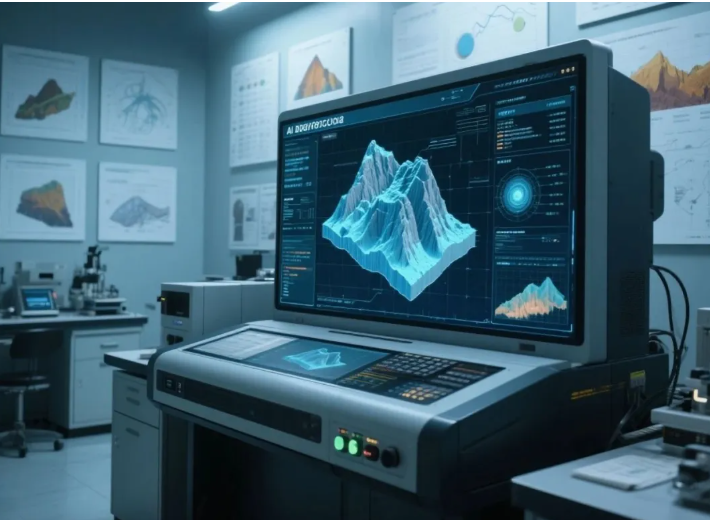
AI is reshaping mineral exploration, from academic research to commercial field applications.
Research integrating Artificial Intelligence with Ambient Noise Tomography demonstrates how regional geological models can be refined using local geophysical and exploration data. Meanwhile, KoBold Metals illustrates how AI, large-scale geological databases and mineral systems science can be incorporated into real-world exploration programmes.
These developments do not remove geological uncertainty or eliminate the need for experienced geologists. Instead, they provide new tools for interpreting complex datasets, testing geological hypotheses and making better-informed exploration decisions.
As demand for copper, lithium, nickel and cobalt continues to rise, the ability to discover and characterise mineral deposits more efficiently will become increasingly important.
The future of mineral exploration will not be defined by AI alone, but by the effective integration of artificial intelligence, geological expertise and high-quality field data.